
“We need not to be let alone. We need to be really bothered once in a while. How long since you were really bothered? About something important, about something real?”
~Ray Bradbury, Fahrenheit 451
By now, especially if you’re of the bookish persuasion, you’ve probably seen the news stories about AI company Anthropic’s wanton destruction of books, likely including rare or even one-of-a-kind titles. The company is buying up books written before 2022, cutting off their spines, scanning the pages so that the contents can be used to train their AI models on high-quality human-made writing, and pulping the shattered remains. Many people are comparing this to the burning of the Library of Alexandria, but my mind immediately went to Ray Bradbury’s classic dystopian novel Fahrenheit 451.
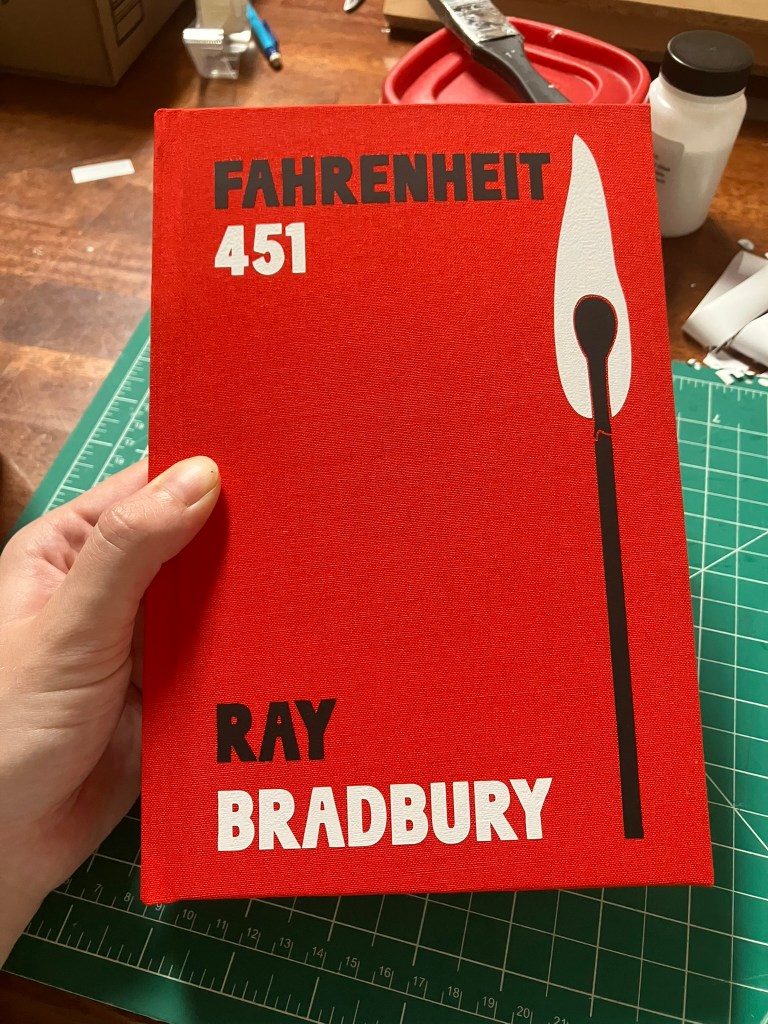
In the novel, Bradbury famously follows the character of a “fireman” named Montag, who’s job is not to put out fires but rather to burn books. Instead of reading, people get their (heavily censored) information from enormous TV screens that fill entire walls of their houses, or from little earbuds that chatter away in their ears. The world of Fahrenheit 451, despite it’s outwardly retro-futuristic 50s aesthetic, is dishearteningly close to our own world of AirPods and big screen TVs and endless distracting content.
Several judges have already ruled that this shred-and-scan scheme complies with “fair use,” arguing that the books have not been destroyed, but rather “transformed” into digital copies. But as any booklover will tell you, a digital copy does not replace a printed book, especially when that copy is kept locked away in a server vault somewhere. Books, as retired professor Faber explains to Montag, have quality and texture. And physical books cannot be altered once they are put to press, at least not without damaging the original copy or printing an entirely new edition. Digital books can be (and are) easily changed and updated at the whims of publishers and tech companies, sometimes obscuring the original work of the author. Once the only copy of a rare book is destroyed, that book is gone forever; it is not functionally replaced by a digital copy.
As a bookbinder and book lover, I believe that physical books matter a great deal. The act of reading a physical book allows us to retain more information than when we read on a screen and books are simply objects of pure delight. Several times while reading my mass market paperback copy of Fahrenheit 451 in preparation for writing this post, I stopped and fanned the pages across my face so that I could smell that musty paper smell, the same scent that wafted from the cheap paperback fantasy books I borrowed from the library as a child. That kind of sensory joy isn’t found in a digital book, and certainly not from the AI chatbot that’s been trained on them.
“Do you know that books smell like nutmeg or some spice from a foreign land? I loved to smell them when I was a boy. Lord, there were a lot of lovely books once, before we let them go.”
~Fahrenheit 451, Ray Bradbury
Books are not mere repositories of information to be harvested and fed into a machine. They are objects of beauty, of wisdom, of true knowledge. They contain living ideas that feed our souls. The people buying and pulping millions of used books, without regard for their content or origins or scarcity, or even their monetary value, are committing an atrocity against knowledge and literacy. They are cutting off at the roots the very things which transmit culture into the future, for the sake of feeding data into a system designed to make intelligence into a metered utility that we must purchase from corporations, rather than cultivate in ourselves.
What can we do?
It feels a little trite to conclude a post on atrocities committed by corporations with a list of things we, as individuals, can do to combat the status quo. But while rereading Fahrenheit 451, I was reminded that the book burnings in the story did not start with a government mandate, but with a public who became indifferent to, and then hostile towards, books. Those of us who love books, who know their value, could do worse than to cultivate our own little corners of the culture to be places where a healthy love of books and reading flourishes, rather than withering beneath the florescent lights of the AI future.
First, do not use AI chatbots and tools developed by Anthropic, OpenAI, and the like. These models are not only developed on the spines of pulped books, but on copyrighted work stolen, scraped, and pirated from millions of artists and writers. They also operate out of facilities that syphon off millions of gallons of drinking water, tax the electrical grid, and harm the health of people in nearby residential areas. I’m sure you know the headlines by now.
Second, prioritize building your own library of physical media (books, DVDs, CDs, vinyl, cassette tapes, or what have you). Public libraries are also an incredible resource, but we need to remember that they are not archives. Books you love may not stay in circulation forever; I know this from experience! So it is vital to build your own library, unique to you and your family, where you archive the cultural works that are important to you. Ebooks and streaming media can be taken from us at any moment, but the only way to take your physical media would be for someone to literally break into your house, and I don’t think we’re at that point yet. 🙂
Third, take care of your physical media so that it will last as long as possible. All good things in life require maintenance! Clean your vinyl records, properly store your CDs and DVDs, dust your books and keep them upright on shelves out of direct sunlight. For books that need a little more TLC, consider repair or rebinding to keep them in tip top shape.
Finally, cultivate a love of reading in your home. It can be as simple as picking up a book instead of your phone at bedtime, or as complex as starting your own book club! Read aloud to the children in your life; they love it and it provides so many lasting benefits. Read to learn, to be entertained, and to grow as a person through the living ideas contained in all great books. It might take a little longer than typing a query into a chatbot, but the knowledge you gain won’t fade the moment you close the browser window.
Thank you so much for reading, and we’ll talk again soon.
Sincerely,
Aria Griffey
Co-Owner and Lead Bookbinder,
Griffeys’ Book Emporium LLC


Leave a Reply